
Identify and refute disinformation narratives
Open sources, including messaging apps like Telegram and WhatsApp, produce more content than any team can monitor.
Factiverse extracts the most controversial claims about elections and conflicts that may be part of disinformation campaigns. It then checks them against sources you trust, so your analyst can gain more situational awareness for their reporting.
Factiverse extracts the most controversial claims about elections and conflicts that may be part of disinformation campaigns. It then checks them against sources you trust, so your analyst can gain more situational awareness for their reporting.




.png)






.png)

Factiverse audited nine leading models on the 22 July attacks for Revontulet.
Industry challenges
The problem
Open-source intelligence has never had a collection problem. It has an assessment problem. Much of the volume is not just noise; some of it is engineered to deceive by antagonistic actors.

01
Volume outruns your analysts. Open sources produce more text, video, and audio than any team can read, watch, or verify by hand.

02
Some of it is meant to mislead. Coordinated disinformation and influence operations plant false claims and push narratives designed to slip past a rushed analyst.

03
The same story fragments across sources. Different outlets, in different languages and with different agendas. They report the same event in conflicting ways, and piecing that together by hand is slow.

04
Foreign-language material sits in a backlog. The sources that matter most are often not in English. They wait while English-language content is triaged first.
Case study
We gave a NATO member state's analysts daily claim monitoring across Telegram, YouTube, and every language they needed
This case study discusses how a NATO defence force turned billions daily Telegram messages and thousands of hours of YouTube content into a searchable claim database to assit their daily reporting.
100+
Telegram and YouTube channels monitored and analysed daily
114
Languages monitored across sources for teams who do not native speaker analysts
24h
From message posted to claim surfaced in the daily roundup
The solution
Factiverse runs the whole claim detection and verification pipeline. From collection to a verified view of which claims and narratives are disputed so your analysts start from organised evidence rather than raw noise.
01
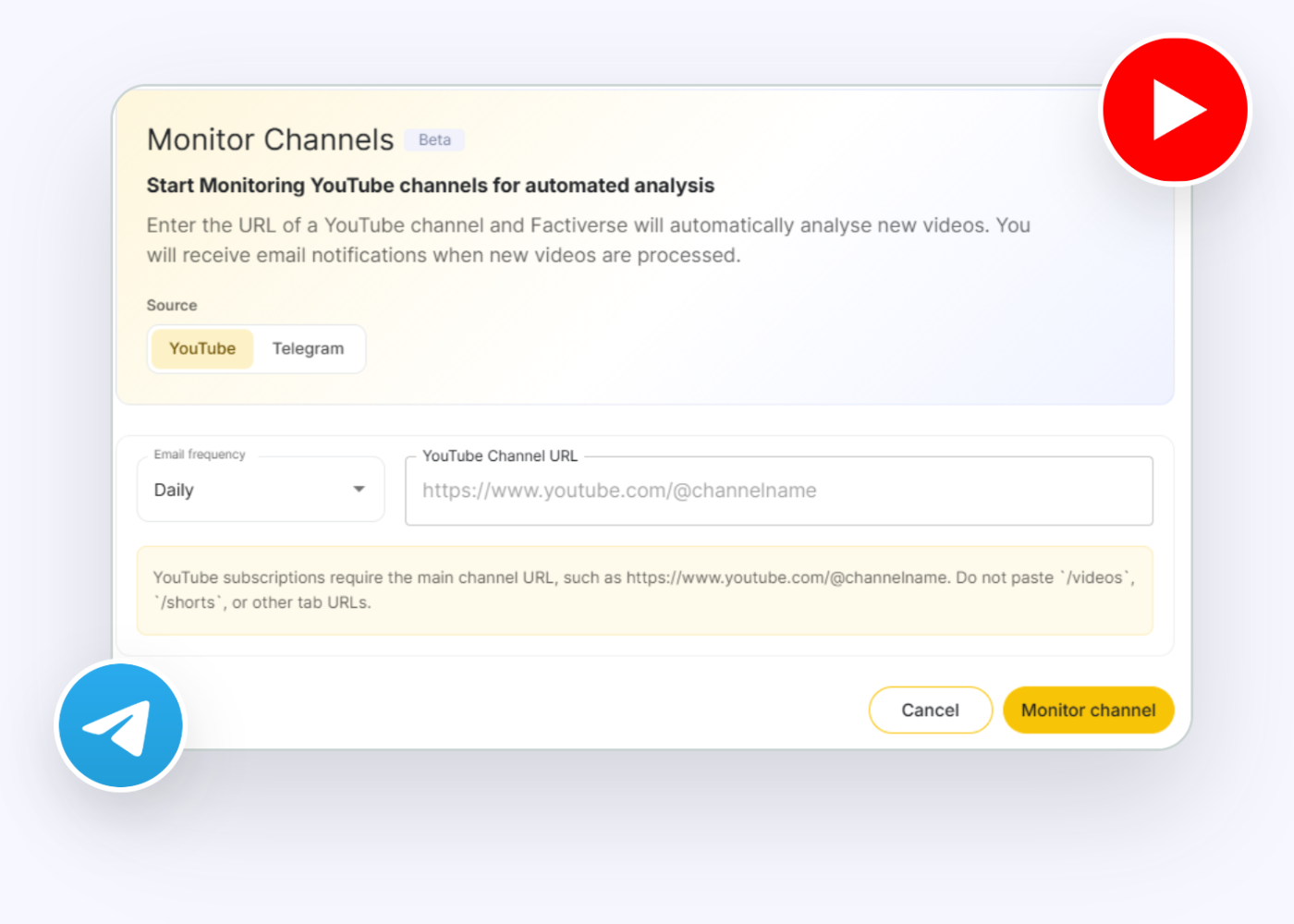
Multiple platforms monitored concurrently
We analyse the sources of information through our own tools. We use our platform Gather and its APIs to analyse platforms like YouTube, Telegram and adversarial media platforms across 114 languages.
These solutions are adjustable to your specific workflows and reporting schedules.
These solutions are adjustable to your specific workflows and reporting schedules.
02
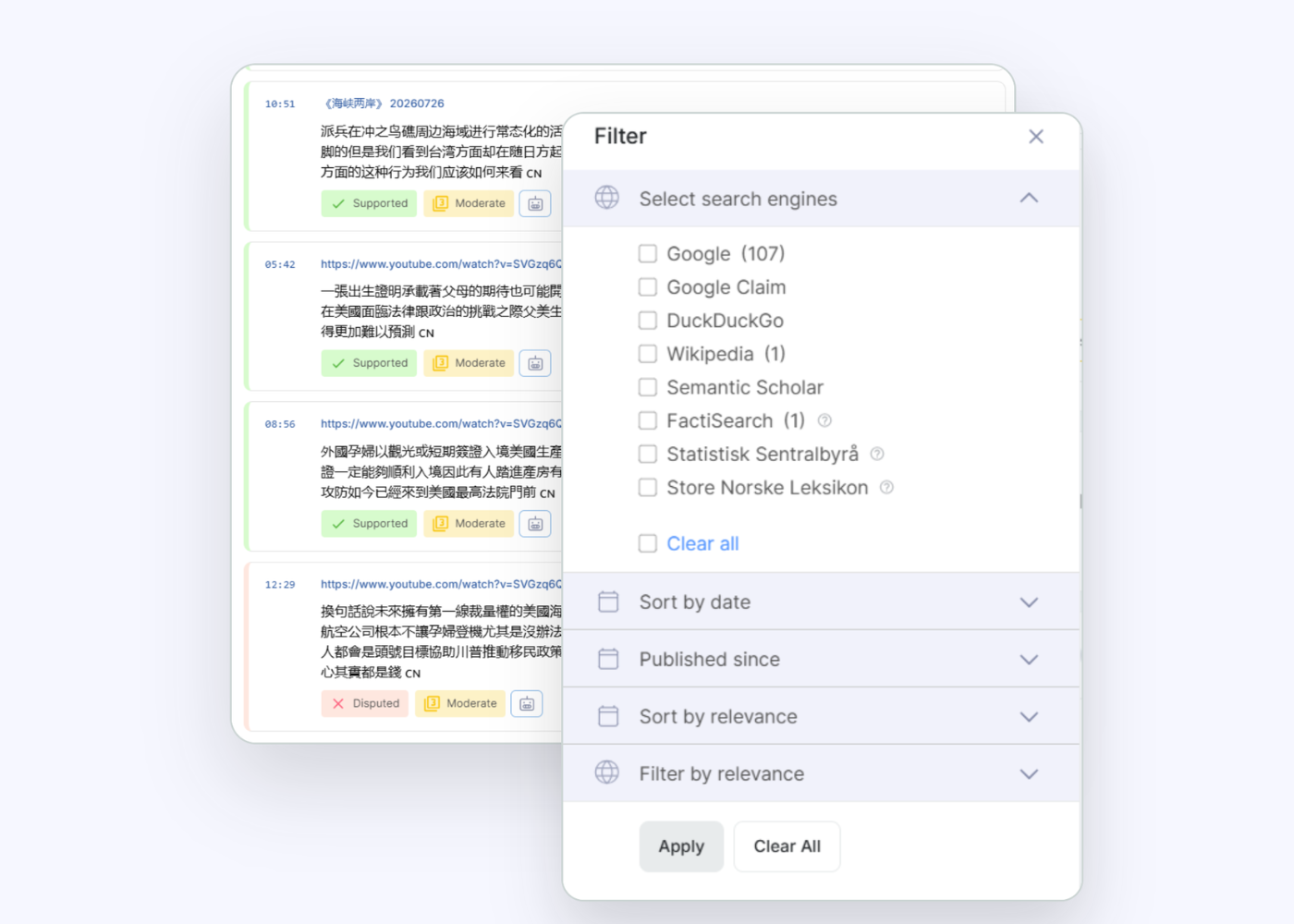
Every claim is verified against sources you trust
Factiverse extracts the checkable claims from what it collects and tests each against trusted sources you help define. Our claim detection runs across 114 languages, including Chinese, Russian, Korean, and Persian. This is so that high-priority foreign-language material is assessed alongside English rather than left waiting.
03
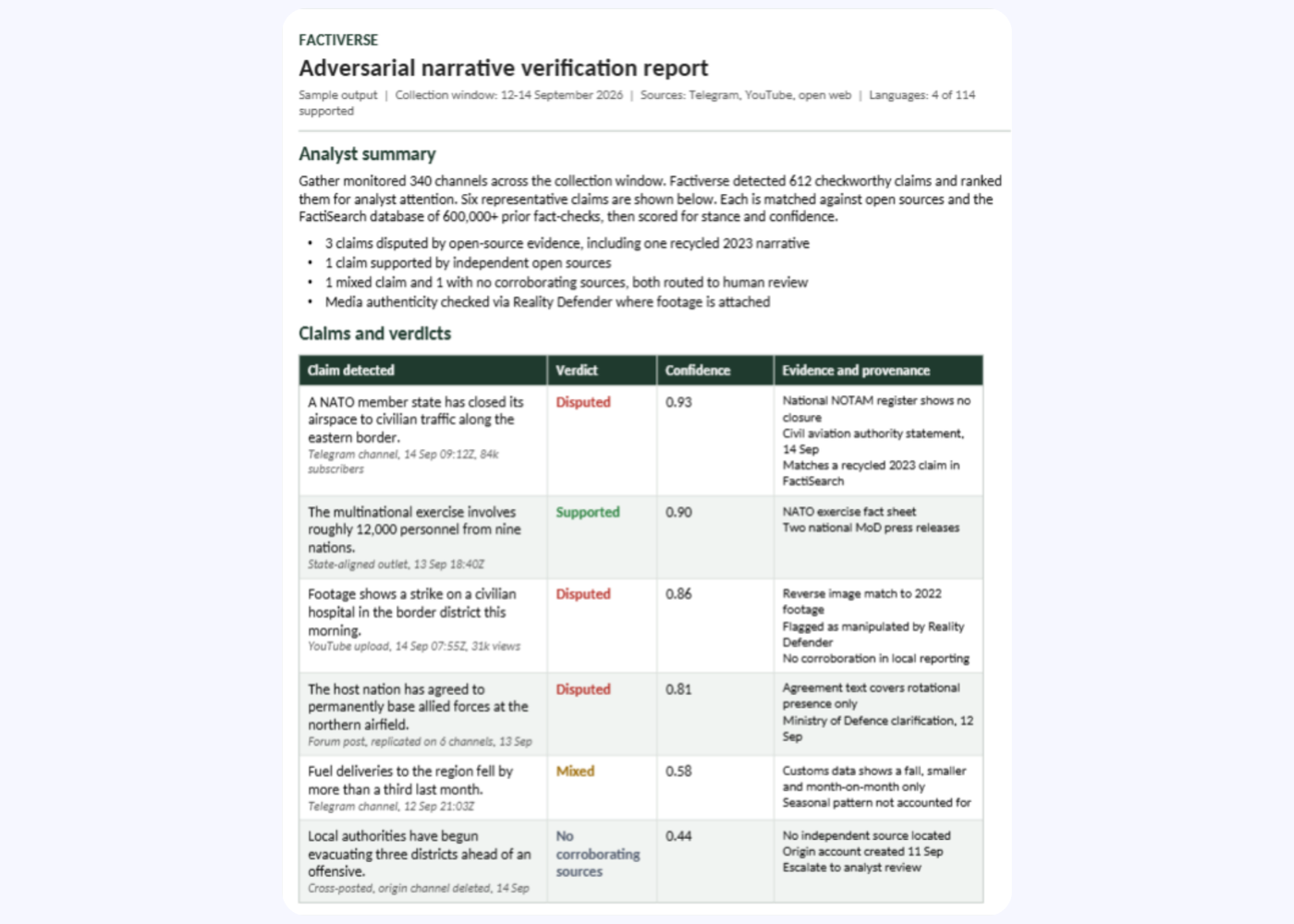
Enhance your reporting with specific claims
By obtaining a list of disputed claims that are judged to be disinformation, analysts can transform them into detailed reporting for their surperiors. Enabling them to increase the rate and effectiveness of their counter messaging to disinformation campaigns.
Testimonials
Trusted by the teams building the future of information.


Political content doesn't wait for you to catch up. Before this Factiverse integration, fact-checking and monitoring political video at scale simply wasn't possible. Now it is — and it works directly inside the Renki workflow our journalists already use every day.

Taru Salo
Head of Digital Development, Data & AI, Viestimedia

The data provided by Factiverse was extremely useful for our outlet in identifying the key Ukraine- and Russia-related narratives circulating in the Czech media space ahead of the parliamentary elections. A major benefit was how efficiently the report helped us pinpoint the key narratives, saving us valuable time in the process and guiding the further focus of our research.
.png)
Martin Fornusek
Senior News Editor, The Kyiv Independent
Even with five people on the team, Factiverse was able to pick up claims from the debates that we missed. The transcript had an accuracy of almost 95%, and sometimes the fact-checks happened as they were spoken. This solution has immense potential and already saves us a lot of time

Thomas Hedin
Editor-in-Chief, Tjekdet
Without more organised cooperation, stronger editorial expertise, and new tools such as Factiverse AI, Finnish media cannot keep up with what is happening around them and in the digital world

Joonas Pörsti
Editor-in-Chief, FactBar
Turn open-source volume into verified intelligence
See how Factiverse collects, verifies, and compares your sources, in the languages and on the topics that matter to you.
Frequently asked
Do you collect the sources, or do we?
We can do both. Factiverse collects through its own tools, Gather for video and audio and our API for text, so you can hand us the tasking and receive verified results. If you already have a collection pipeline, we plug into it instead.
What sources can you handle?
Text, video, and audio. News, social media, forums, reports, and research papers on the text side, and broadcasts, podcasts, and video clips through Gather on the video and audio side.
Do you decide which source is telling the truth?
No. We verify each claim against sources you trust and lay the sources side by side so you can compare them. The analyst draws the conclusions; we provide the verified, organised evidence.
Can we define which sources you verify against?
Yes. You help define the trusted sources, so assessment reflects the records and outlets you stand behind rather than a generic reference set.
Can it work in more than one language?
Yes. Verification runs across 114 languages, including Chinese, Russian, Korean, and Persian, so foreign-language sources are assessed alongside English rather than left in a backlog.
How is it deployed, and where does our data go?
Deployment is scoped to your security requirements, including data residency and controlled or on-premise options. We will work through your constraints as part of the engagement.
Why not just use an LLM for this?
LLMs work at small volume, but not at the throughput open-source work demands, where they become too slow and too costly. The Factiverse claim detection model is built for that scale.
Learn more about verification at scale

.png)
By the way
Subscribe to our newsletter to receive important developments about everything AI safety related


Discover how Factiverse solutions can help The Research Video and AUDIO for your teams