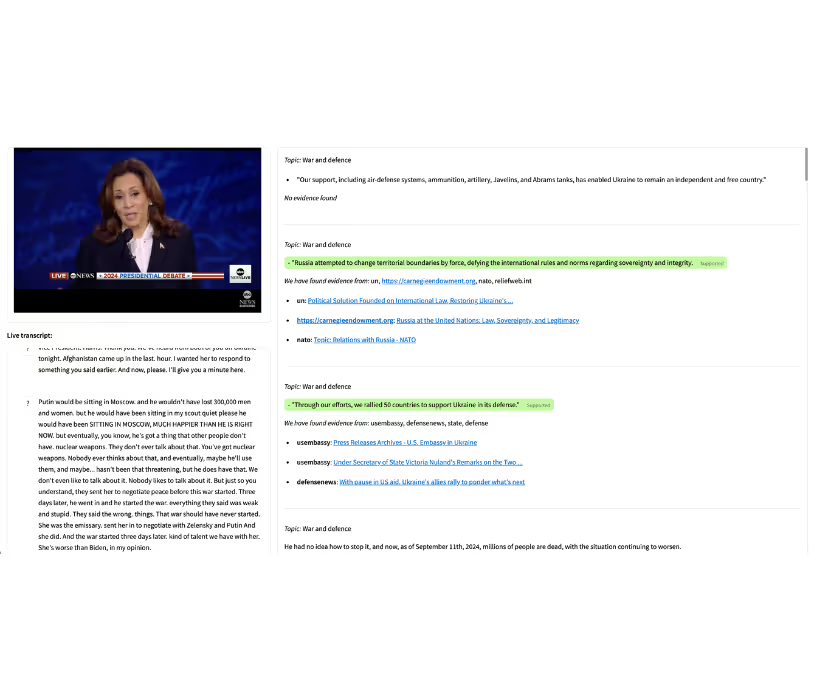


15 billion messages a day. One narrative can break a democracy.
Telegram, YouTube, and the limits of human analysis
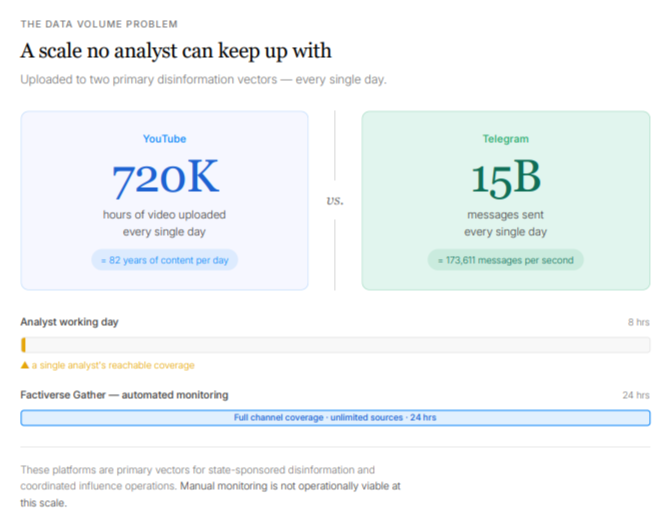
Telegram now handles roughly 15 billion messages a day across more than 900 million users. YouTube takes in about 20 million new videos every day. Most of that volume is mundane. However, some of it is highly operationally relevant to the defence forces of NATO countries (SOURCE).
Telegram, especially, is actively used for foreign influence campaigns, drug dealing, and scams with little to no oversight. An investigation by The New York Times in 2024 concluded that “Telegram has become a global sewer of criminal activity, disinformation, child sexual abuse material, terrorism and racist incitement” (SOURCE). Wagner Group coordination has been documented on Telegram, alongside coordinated promotion of pro-Kremlin narratives across YouTube channels.
For military analyst teams in NATO countries, manually monitoring these platforms is structurally impossible. They miss out on information that materially affects high-stakes decisions regarding democracy, safety, and the stability of Europe.
The challenge
In 2026, Factiverse worked with a team of military analysts in a NATO country to address this gap. Before building, we assessed the available alternatives. Three weaknesses were consistent across existing solutions:
Sentiment and keywords are not enough. Most monitoring tools surface aggregate sentiment and keyword hits. Neither tells an analyst what is actually being claimed, by whom, in what narrative frame, or whether the underlying statement is worth investigating.
Retroactive analytics are too slow. Telegram data is hard to access in real time. For strategic decision-making, that gap is the difference between acting on a narrative and responding to one.
Scale defeats the existing tooling. The customer already had robust systems for digital print media. The rise of high-volume video and messaging platforms broke those systems, making it challenging to scale to new information formats.
No multilingual coverage at depth. Narratives about the customer's country are often first produced in adversarial languages. Without proficient speakers across the relevant languages, those narratives reach the public before the analyst team is aware they exist.
The cumulative effect: without continuous, multilingual, claim-level coverage of the platforms where adversarial narratives now originate, a defence force loses the contextual ground truth it needs to act ahead of a narrative rather than behind it.
The Factiverse solution
Factiverse addressed the capability gap through two new core features to our media monitoring application, Gather: Telegram Chat Monitoring and a Claim Narrative Database Dashboard.
Telegram monitoring
Where traditional tools stopped at the edges of social media, Gather went further. Gather can now scrape full conversations and data from selected public Telegram channels daily, surfacing claims and statements from the past 24 hours. It supports time-based filtering, multi-language search, and verification against trusted sources.
Every day, the defence force receives a roundup of the most interesting and noteworthy claims across key and specified channels on Telegram, including across languages they do not have analysts proficient in.
The result: the defence force can effectively monitor key information sources on Telegram that it would otherwise lack the bandwidth or language capabilities to cover. Information gathered for reporting to superior officers is now more nuanced and complex, encompassing a strategic information platform previously invisible to them.
Claim Database Dashboard
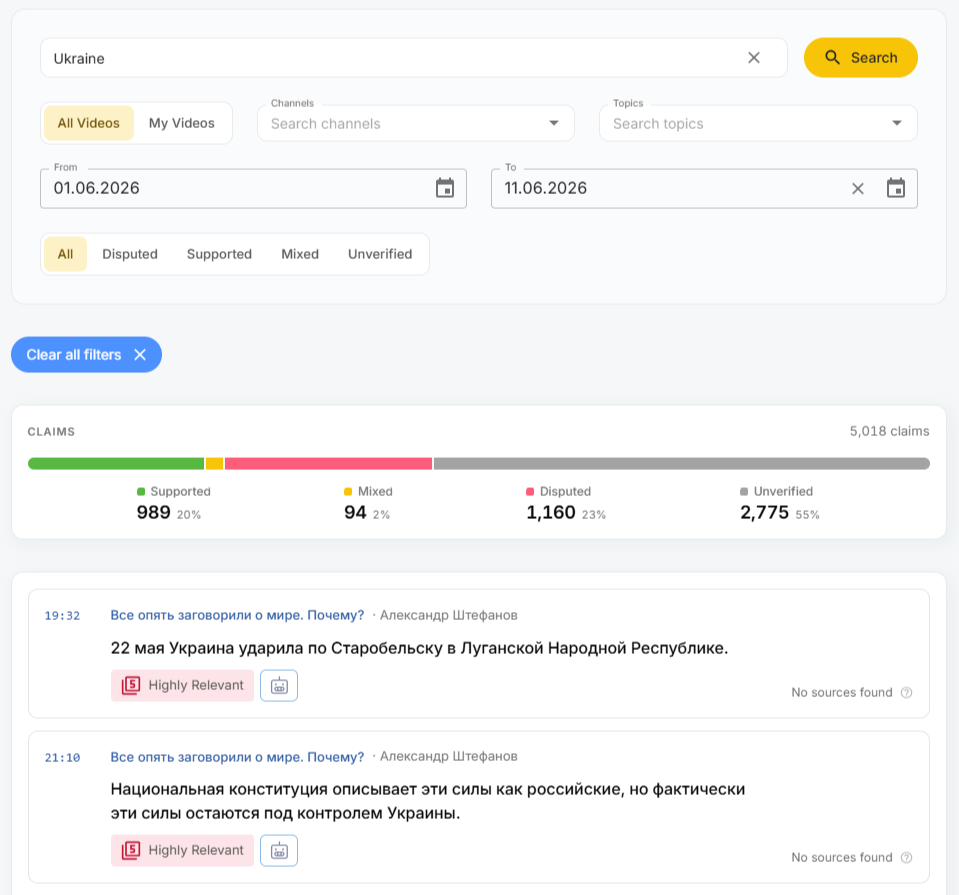
The defence force requested a searchable database of the claims gathered using the product. Factiverse had stored these claims on the backend, but after discussions with the analysts, it became clear that passive storage wasn't enough. The defence force wanted the capability to review and filter claims by date, channel, and claim verdict.
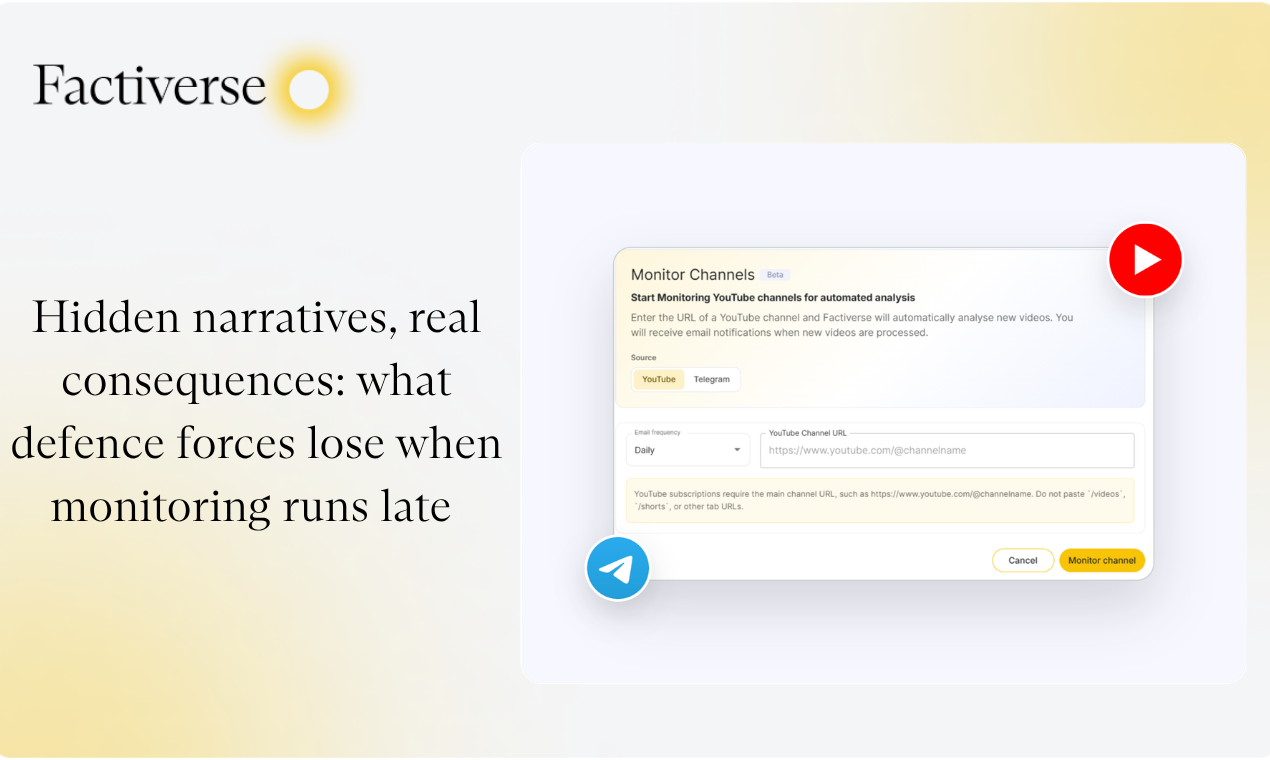
Analysts can now search across all analysed claims by topic, entity, public figure, time frame, and verdict, with full multi-language support, drawing on both YouTube and Telegram sources. When analysts want to monitor and review an information source, they indicate the YouTube and Telegram channels to monitor. For example, an analyst monitoring NATO communications might add the NATO News YouTube channel as a monitored source (used here as an example). From there, the dashboard surfaces everything relevant. From there, the dashboard surfaces everything relevant.
The result: this creates a fundamentally different review capability that enables analysts to get an overarching sense of what is being communicated online in digital spaces. Hundreds of hours of content and thousands of messages can be monitored, and claims can be reviewed and filtered, enabling defence analysts to report on topics of strategic and operational interest.
The moment it changed
One interaction crystallised the value of what Factiverse had built.
A defence analyst had always struggled with how to cover topics not in their native language and across countries they didn't have the bandwidth to monitor. It was a structural problem with no obvious fix inside existing tooling.
Their first search in the Claim Database Dashboard changed that. They immediately saw claims about their strategic priority in other languages they didn't have the bandwidth to catch. This one search suggested they could expand their monitoring capabilities without additional resources. The end result is that they are now discovering a variety of narratives being discussed through these digital platforms that they were not aware of before.
This additional context has allowed them to make their reporting more nuanced across languages and regions worldwide. What had previously required either a native-language speaker or months of manual tracking was now surfaced in a single search within Gather.
During the exercise, one analyst ran a search on a priority topic not in their native language or English, but in Russian sources where the team had no capacity to monitor natively. The results surfaced a coordinated set of claims targeting national military credibility, like “X Country is becoming a NATO launchpad” that had been circulating across monitored Telegram channels for _3 months at least without appearing in any existing reporting.
The analyst flagged the findings to their superior the same day. These were included in the daily threat summary list, and pinpointed for further monitoring.
What previously required either a native-language contractor or hours of manual triage was surfaced in a single search. The analyst's assessment: “Identifying when identical phrasing appears across multiple sources is helpful for military personnel to be able to 'put two and two together" themselves”.
The threat landscape doesn't wait for analyst bandwidth to catch up.
Book a secure briefing with our team to enable your defence analysts to multiply their monitoring capabilities and identify harmful narratives within their workflows.
Defence and government teams operating in NATO or EU member state environments can request a structured pilot assessment through Factiverse's government engagement programme. Pilots are scoped to your monitored channels, languages, and reporting cadence - and can be operational within hours.
Contact us: sales@factiverse.ai

.avif)