

Full Paper
FlashCheck: Exploration of Efficient Evidence Retrieval for Fast Fact-Checking
By Kevin Nanhekhan, V. Venktesh, Erik Martin, Henrik Vatndal, Vinay Setty & Avishek Anand
The problem
As the volume and velocity of online disinformation increase, it becomes crucial to automate certain tasks of information verification to ease the burden on human fact-checkers. Especially when it comes to real time fact-checking, automated systems should be able to quickly search reliable databases like Wikipedia to verify statements.
However, searching through millions of lengthy articles creates a severe retrieval bottleneck, making traditional AI fact-checking tools slow, memory-heavy, and expensive.
The solution
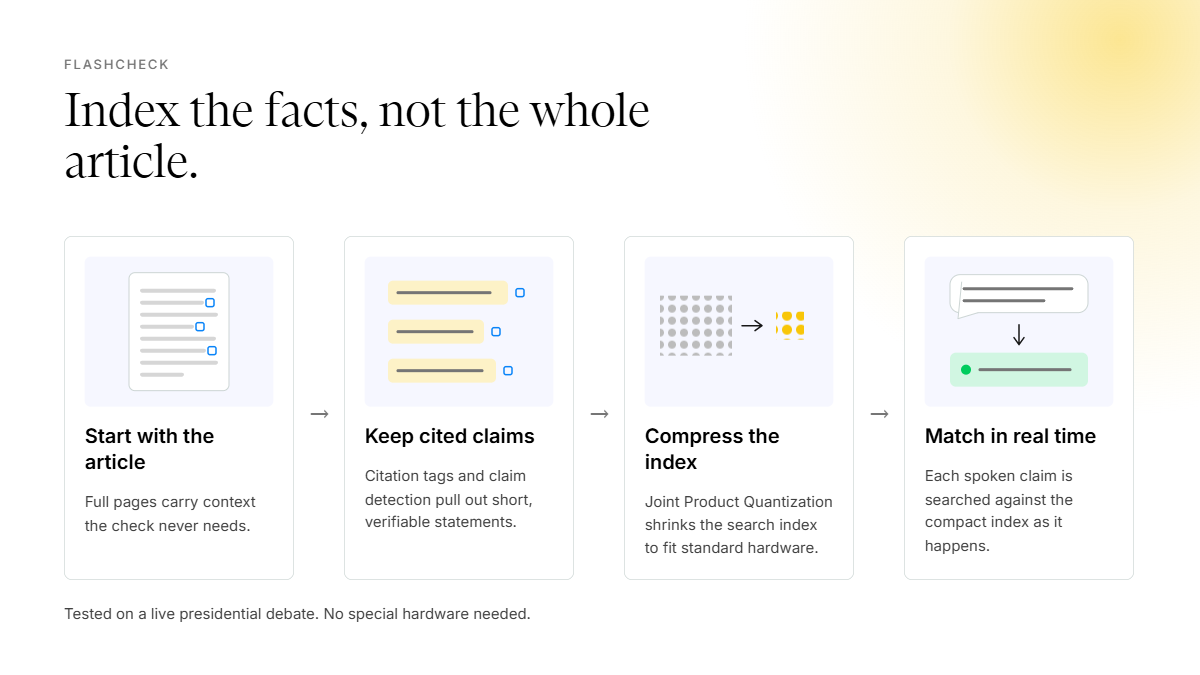
To solve this issue, Factiverse researchers contributed to developing FlashCheck, a system to streamline evidence retrieval. Rather than scanning complete Wikipedia articles filled with non-essential context, FlashCheck extracts only concise, verifiable factual statements using citation tags and claim-detection AI. To accelerate searching further, it applies an index compression technique called Joint Product Quantization (JPQ), which shrinks the search index memory footprint by 93%.
The results
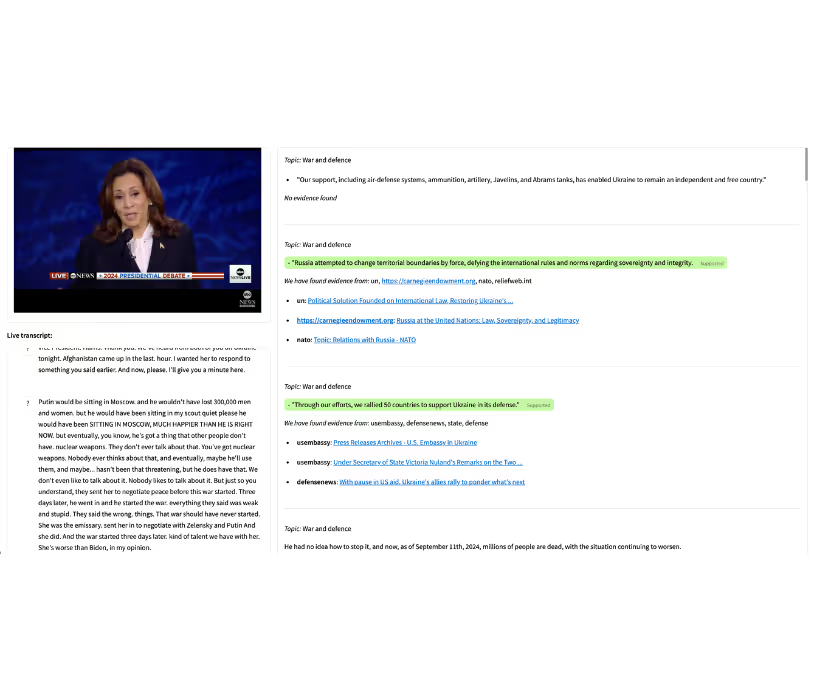
In real-world testing on the 2024 U.S. presidential debate, FlashCheck delivered rapid, reliable claim verification. This innovation makes real-time, automated fact-checking feasible on standard, lower-cost computer hardware.