

Full Paper
Multilingual Fact-Checking at Scale: Fine-Tuned Compact Models vs LLMs
By Pratuat Amatya, Vinay Setty
The problem
Fighting misinformation globally requires systems that can process online content on a large scale. They should quickly and accurately identify and verify relevant claims across dozens of languages. While many tech platforms rely on Large Language Models (LLMs) to verify claims, these commercial systems are often too slow, expensive, and risky when it comes to privacy for journalists and fact-checkers.
The solution
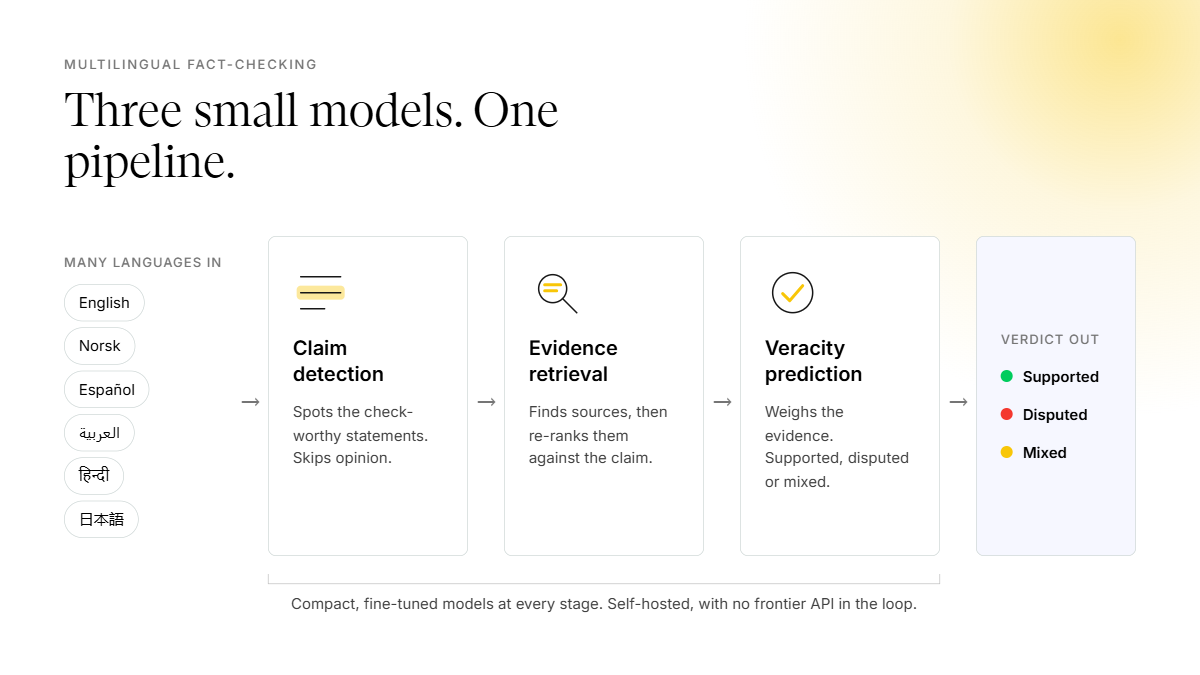
To address these challenges, Factiverse researcher Pratuat Amatya and our CTO Vinay Setty evaluated Factiverse, a production-grade, modular fact-checking system. Instead of relying solely on LLMs from frontier companies, Factiverse combines specialized, compact AI models across three core stages:
- claim detection (identifying check-worthy statements);
- Retrieval and re-ranking evidence (to match to the claim);
- veracity prediction (determining whether the evidence supports or refutes the claim, or gives a mixed result).
In tests up to 114 languages, fine-tuned, self-hosted encoder models consistently rivaled or outperformed major LLMs such as GPT-5.2 and Claude Opus 4.6.
The results
These compact models process claims in milliseconds for under a penny per thousand decisions. Moreover, it maintains a higher consistency in low-resource languages, or languages that lack the large-scale datasets for training algorithms. Ultimately, Factiverse system demonstrates that smaller, specialized AI tools can offer a far more reliable, private, and cost-effective way of conducting fact-checking on a global scale.